Just Great Days on the River

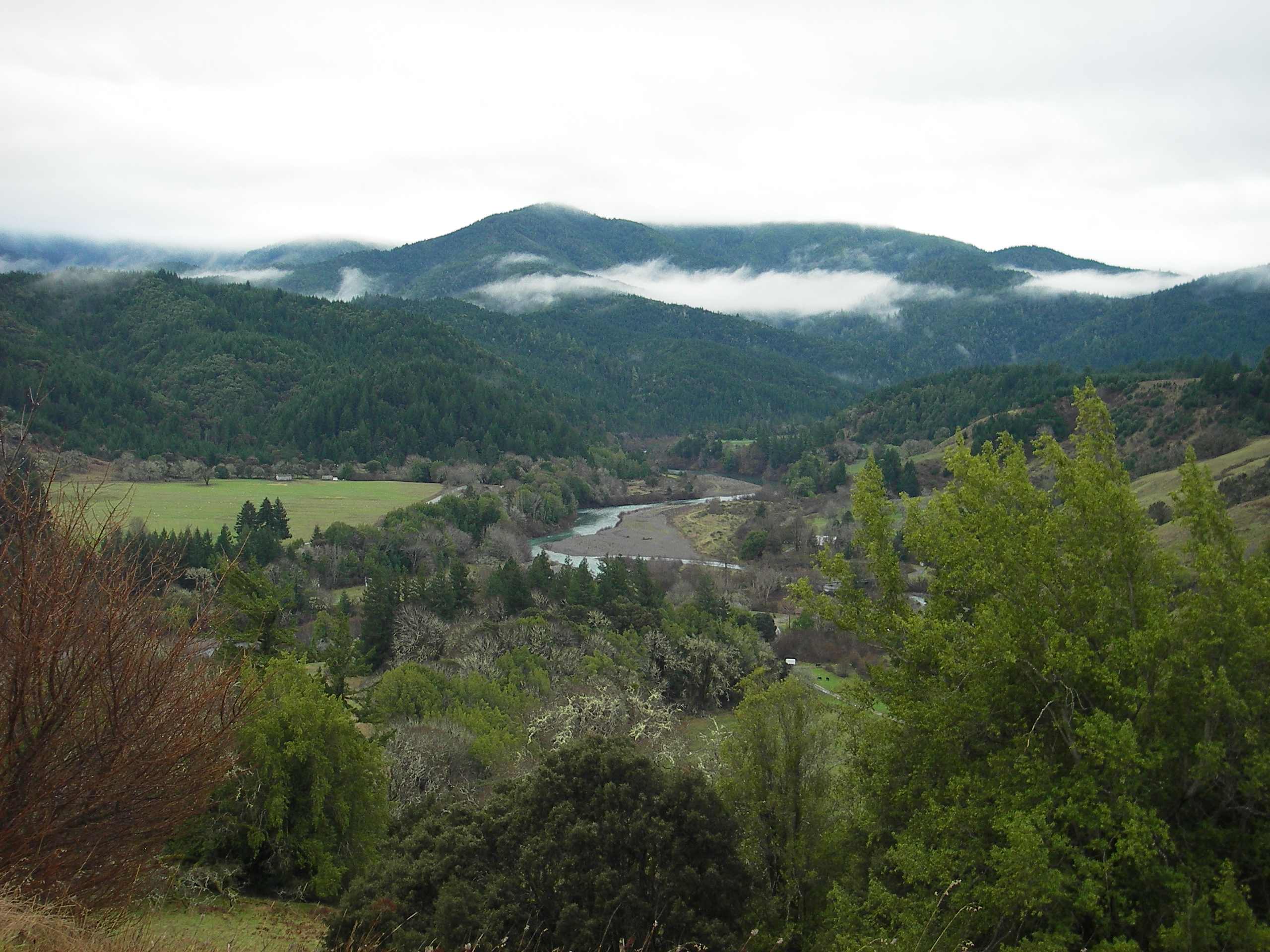
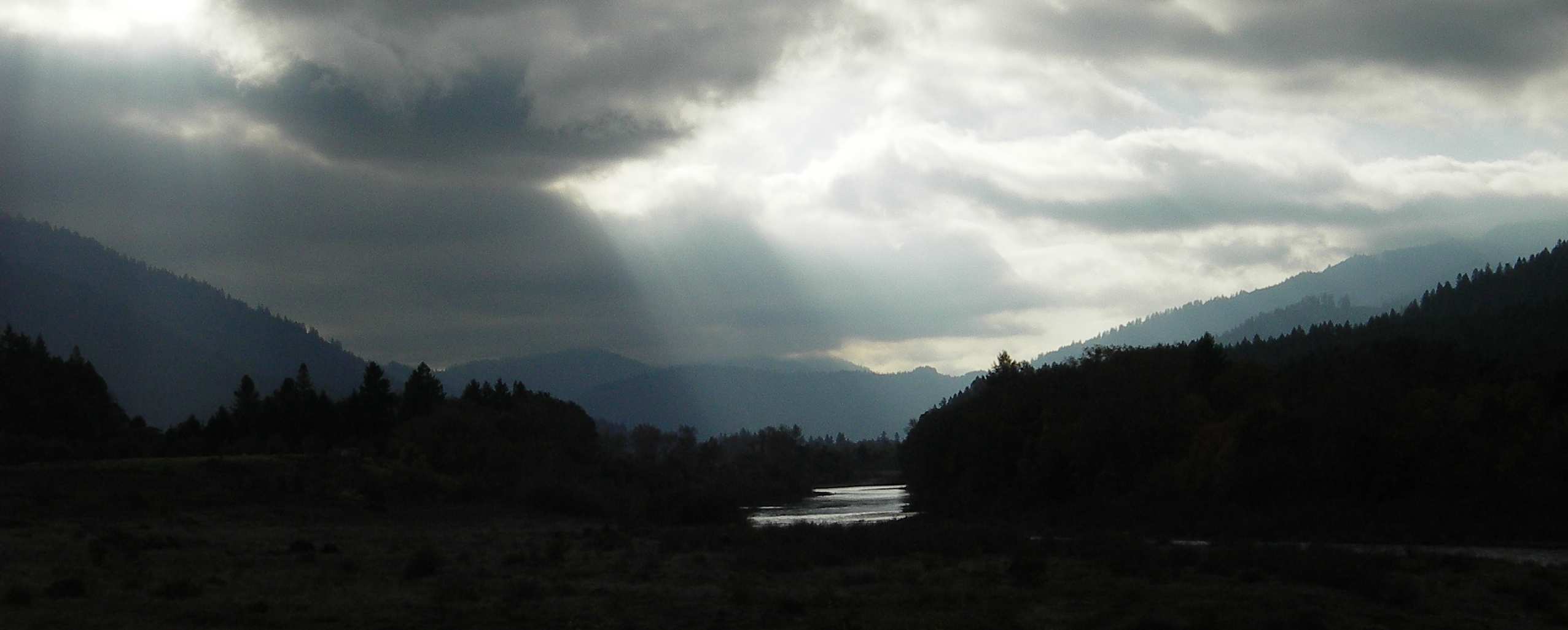
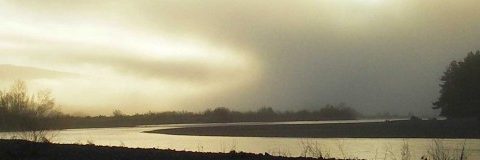
Late February, like it always seems to do, ushers in the bitter cold of arctic winter with snow all over. I don’t really recall wrestling with any “decision” this go ’round – I had a gathering to attend and the river happened to be on the way, along with snow, more winter, and the barest hint of spring given away by longer days and the buds of streamside willows. Dropping down into the valley, the horizon is sprawled with black clouds, streaking virga, and the intimate play of morning light across everything: somehow, the nastiest of the weather is not here, only suggested in the vistas of snowclad lowlands and restless looking skies.

The only decision is where. And I replay the fantasy of the long, slow bottom half of the Anderson run where the conditions seem set up for surface feeding fish, easy wading and the good promise of solitude. If not this fantasy then the riffle at the bottom is ever dependable. This is the piece of water that might take me five years to catch a fish in the way that I dream about on long, rainy coast-bound nights. I can always catch fish here, but there’s something about the “situation” that you find yourself catching fish in that makes it somehow intensely, cerebrally satisfying.

Let me jump to the punch line: it was on the minute I approached the water. But wait – even this takes some understanding. You see, these fish don’t give themselves away so easily. Oh sure, you’ll see a fish rise here, maybe there. But just stop. Stop, breathe, listen, look. Then it comes alive. The fish sip in emerging baetis or some other small, olive mayfly with gentle, purposeful, ultra-efficient movements. The biggest fish give themselves away with the flick of a very large tail barely slicing through the surface. Some fish work the edge of the moving water where the flow is easy. More fish delicately nose through the calf-deep shallows of the margins picking off bugs that wash into this forgotten realm. A few caddis take flight, the water is colored pewter with the black clouds painting an electric energy across everything. The fish, the bugs all seem to agree. There is a loud, urgent and anxious rhythm established when the bugs are emerging heavily, the fish are feeding and the weather is vibrating.

So it’s dream fishing – knee deep water, big, spooky trout, but not overly selective. Colorful, rotund rainbows that pull line from reels and make you want to talk in whispers like they might hear your cries of delight. One after the other. Later on, in early afternoon, the caddis emergence kicks in following a brief snow squall. A bald eagle watches from the top of a snag across the river – wondering who this curious critter is, on knees, hunched over in inches of water, casting to snouts and tails with intense abandon. Swaths of sun, rainbow, silver and gold color the scene. The baetis alternate with the caddis and at one point I just step back and watch the parade of bugs littering the water, floating silently down. Tails, snouts, splashes all add to the ongoing rhythm, uninterrupted by a flash of lightning and thunderclap.

I can’t say the “bar has been set” or “this is as good as it gets,” rather, this is the culmination of five years of work, patience and observation. I’ll be back soon, to find myself in an entirely new situation and reveling in the simple fact that it is bound to be different. It’s why I fish – if it were the same every time… well, that would be a different story, I suppose.

How Winter Wanes (A Corrolary Tale)

It was just the turn of your head,

Like the fields where we ran as kids

Tall, through the rolling grass

Skipping, hollering, laughing

endless imaginings!

That was when Springtime never ended.

.

Now we start it off again, here,

like then. Your eyes, your hands

Immersed in the window’s view,

Across the fields, to where the hills rise up

Collecting it all into the little streams

Reflecting in the midday sun.

.

Humming, softly in the warmth of that day

When we opened doors for the first time.

And in came light and breeze and linens swaying,

Entwined in a caress that never stopped.

.

And just as you turn again,

The faint scent of you, lingering.

I never remembered, until now,

like the stream where the oak trees grow,

The tiny home over the hill,

We don’t have to know anything more.

.

Nobody told me it would be quite like this.

.

How was I to know all the questions,

You look away, I wonder,

All of that was answered,

A long time ago. Nothing more.

I didn’t have to.

.

As children, we could study the

Long swoop of a single flower petal,

Seeing the landscapes rise and fall.

.

And in the one moment,

Your sure glance weaving a simple thread

Of lush green garden into my heart.

.

It has been a long time, my love.

.

All those things happened, then.

Now we turn, move into the place

Where the light fades from an afternoon

Sitting in the still air of an early evening.

.

That was your hello.

How Winter Turns to Spring (provisional)

The story plays out each time I crest the small hill

Especially in March with the first fresh winds.

That’s when this time is just like before

Any every past year at this time

Gets bundled up in this moment once again,

Somehow eluding time,

Or, strings those years together in one long now.

.

The truck rattles over the small hill,

While I still carry the sleep

That barely took hold last night.

One of those rare nights

The tossing and turning

Hoping to shake it off.

.

The thoughts coming as little sprouting flowers

Then roll over once more

To see them as festering memories

That won’t leave.

They come in on that breeze, maybe.

Just like last time.

.

That night the light rain dripped off the eave

Into the puddle by my window

Speaking in between all those thoughts

That can’t quite hear the steady rhythm outside.

.

Rolling down the hill, the day

Seeming like it could be the last

Feeling like maybe the first.

.

The day little routines go wrong,

Bringing a stutter step to the movements

In a day that rings in the last of that

Or ushers in the first of something.

.

This day rides on the hope of something,

This, or that, but really,

All the while,

The day just hovers in between.

Just like it always did.

It’s always just in between.

.

The early evening drive into town

The hum of the tires over the rough asphalt

Turning west,

Where the sun sprawls over the

rain clouds, painting a familiar picture

The colors announcing the last of the day

Or, maybe the first of something.

.

But never in between,

No idea of in between.

.

Like it just might be this,

One-more-time.

So that tomorrow might be the first or the last

Of something.

.

Yes, somehow, I skipped the in between

Coming over that hill this morning.

Forgot that it might be just like it always was

And always will be. In between.

Just barely,

In between.

Barely.

Mother’s Poise


In the broadest of strokes,

The brush that paints sky onto land,

So your voice brought sorrow to the downtrodden.

A fortunate sorrow, one seen now,

So that they might cast it all away.

Now they live in the sky

And bring the color to our lives.

On the gentlest Spring breeze,

The last gasp of restless winter,

So your movement brings warmth to the shadows.

And they all curl up into tiny specks,

And whisper all night long,

About the people they used to be,

The people that live on the wings of the wind.

Across the grassy fields,

That roll into distant landscapes,

You sit there, eyes full

of the silent spaces you wish for us all.

Celebrating Emerald Water

It’s been awhile since I’ve posted anything fish related – anything at all, for that matter. To that end, I thought I would get down in the weeds with steelhead.

As usual, a difficult decision hung over a potential outing for Sunday:

Option 1: Travel inland where big rainbows would likely be surface feeding on emerging baetis on the wide waters during the early afternoon. The weather forecast supported this option with warm cloudy skies and a chance of rain with calm winds. More forecasted rain would have been nice for the baetis, but, still, the prospects looked good. I had done this trip last month and was satisfied all around with the day. It’s just an ideal fix, a little taste of summer in the middle of winter. What could be better than the chance at a 20″ rainbow on a small dry fly? well….

Option 2: Travel south to a certain secret Lost Coast river in hopes of connecting with a wild steelhead on a deeply swung fly. Despite most other rivers being unfishably high, the gage showed this river at ideal levels. I was a little skeptical of the gage – we had just come off a significant peak flow two weeks ago, so the gage might be off. Yet, looking back, the tell-tale signs of a gage re-adjustment were showing on the graphs – so I had most every reason to believe the displayed flows were accurate – save for all the surrounding rivers being too high. It would be a bit of a gamble. And if it was right on, wouldn’t half the county be there fishing?

These decisions are not made lightly. Every possible aspect is weighed and revisited while trying to fall asleep with still no plan.

I arrived at option #2 early the next morning. The rain forecast for inland had been trimmed back more – pulling it a tad farther away from ideal than I wanted. Plus, it was really mild overnight – perfect for coastal rivers and their fish. Off we go with spey rod in hand…

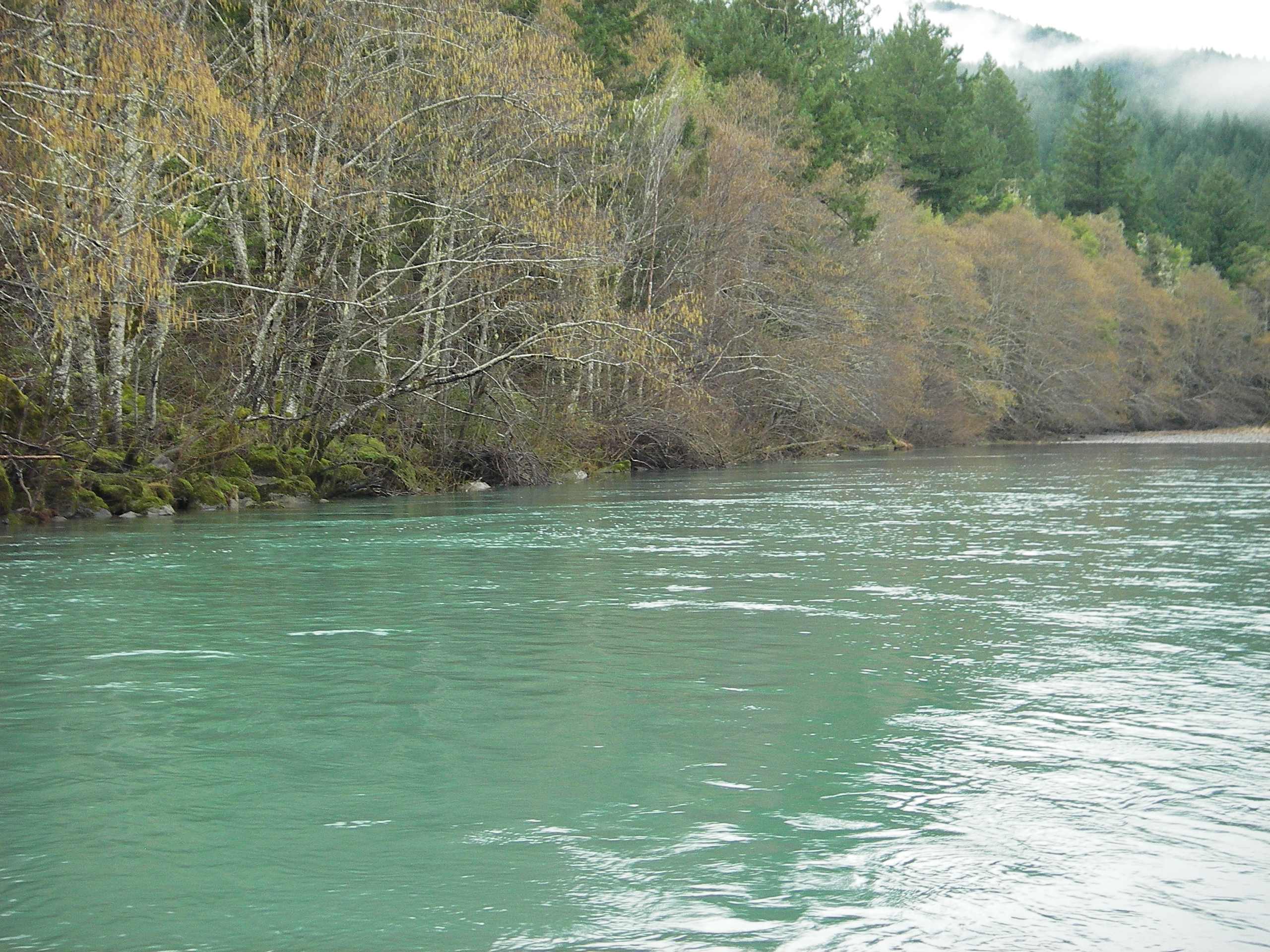
Describing the “perfect” water color for coastal stream steelhead fishing is a fun intellectual exercise, but, in reality, it either is “sweet”, “not quite”, or “blown.” The first look at the river usually produces one of these responses. A blown river is pretty straightforward – keep driving, find something else to do, or go home. Not quite water is usually a recipe for a fruitless day. It’s the type of water that doesn’t call to you. You have to go to it. Sweet water is rarely debated. It is mysteriously green – just clear enough to reveal a glimpse at a secret underwater world, but dark enough to be mysterious and engaging. Green water draws you to it. You can’t just pass by it. When you walk up to it, the water beckons closer inspection. Lighter-colored rocks are visible in the deeper runs, maybe. It’s the color of water that seems to match the body of a steelhead perfectly. The bottom is full of ghostly shadows, movements and colors. The thing with perfect water is that it gets even better after a day or two. What’s perfect one day is even better the next and so forth until one day it’s suddenly too clear – just like that – or the rain kicks up again and the whole process starts over again.

The other challenge is trying to find the water that is optimally fishable with heavy sinktips and weighted flies. These are usually the broader runs and slots. I don’t want to rule out the narrower chutes and deeper pools, and many more accomplished folks will fish these as easily as any other water. But, for me, finding that wider water, where the bottom wells up in gentle slicks along the surface and maybe fans out a bit before reaching the next riffle is the ideal. Take this water and litter the bottom with larger cobbles and smaller boulders, with stripes of sandy gravel between, and an afternoon could be spent probing it’s depths. For me the challenge is finding the right pace of fishing through the run before I get bored of it, but being able to cover it entirely. I could exhaust myself refining each swing so that a new piece of bottom is covered before I even take a step. If I fish through too fast, I don’t cover the water. If I fish too slow, I get antsy and lose my focus in critical water. Therein lies part of the challenge: with water this good, it ALL looks critical. So the fishing becomes a waltz between intuition, persistence, and being able to just move on. When in new water, there is the temptation to fish too fast through great water thinking that even better water lies around the next bend, which may or may not be true. Then there is the dilemma of the surfacing fish in difficult water. The splashy chromer in that fast, deep trough may draw more time and energy than would otherwise be alloted to such marginally fishable water. Here, fishable being a deep, slow swing. Not that it can’t be done….

Finally it all comes together in a piece of water that just seems designed for a marriage between steelhead and fly. The notion that better water lies around the next bend is still there, but this is the type of water that seems to evoke some forgotten memory of being taught what “perfect” water is. The swing is perfect, the water itself seems somehow apart from the rest of the river. This little piece has been set aside to a place where time gets thrown out, intuition and persistence merge and the game is on.

Fresh winter steelhead don’t always attack with ferocious abandon – that say a late winter/early spring runback might do, or a warm water fall fish. It’s that stop in the middle of a swing covering nearly the same water for the third time. This aint no rock. Rather, it’s all about that first lift of the rod into a blur of deeply pulsing rod, knuckle-busting reel, and a split-second mental hesitation – is this for real? It can happen that fast, and when the fish holds; the water, the river, the landscape suddenly opens up. For me, it then becomes not finding some philosophical essence to the moment, rather, it’s all about adrenaline. It’s the stuff that leaves us shaking. After releasing such a fish, we might find ourselves walking a bit taller, speaking a bit more confidently and just feeling all around satisfied about everything. It’s the stuff that will carry with us for a day or two, maybe a week? Then, that critical urge will rise up again. And a decision will be at hand.

Even from far away, the calling of sweet water can usually be felt. With this view, there was no question.
We can debate perfection, but that's just it - even perfect water can get better.
Wild winter steelhead on a swinging fly.
Mirror to another dimension

The Way Fall Remembers Summer (less worrisome version)

An afternoon moment remembered:

Where the last bit of her laughter,

Down to a last breath,

carries, and hangs on the air.

This is when every piece of her

Comes forth in smile and laugh,

Seeming just like it always was,

Only to float off,

Leaving a lingering stillness.

Just an afternoon moment remembered.

The landscape moves now,

And a story is retold,

In great big drifting circles and musings.

With chapters of far off places,

And quotes from the memories of old men.

She tells the story ever so carefully,

While her hands carry it along,

Her arms bringing life to those places,

Her voice filling in the spaces.

All this before the long pause in her eyes.

Commencing soon after the laughter

Was carried away on the last breeze,

Letting the memories grow and unfold,

In that fantastic way memories can become.

These are the moments found here

Wondering around each day,

Just like before,

And like they will probably always be.

Even better than I remember.

Somewhere in the afternoon,

If I look closely, will be that space

That single waiting stillness,

Where her laugh never stops,

And we trace those circles,

Recounting the stories again, all full of life

And see the way things really are.

The Way Summer Turns to Fall

It carries on the last bit of her laughter,

That last breath hanging in the air,

Just for a moment.

When every piece of her

Comes forth in smile and laugh,

Like some restrained ecstasy

Seeming ready to burst.

Then floating off,

Then, stillness.

She moves with purpose now,

But with a strange habit of

Great drifting circles and musings,

Like a big river, meandering, eddying, floating,

And, in time, maybe, finding itself again

Where the wandering currents combine,

And move onward to far off places.

She tells the story ever so carefully,

A story told again and again,

A story of places, a story of movement

All the while,

Her arms carry it along,

Her hands bring life to those places,

Her voice fills me.

Then, the long pause in her eyes.

Long after the last piece of laughter

Had vanished into a long wait

A fear comes over me,

If only I could sit still then, instead I’m frozen

Again.

This is my one chance, before I miss it all.

Again.

You see,

Hers is a story of the way things are right now.

Not what will be, as I want to think.

Nor just the way I remember it.

In that kind of way that memories can become.

Maybe,

Someday, I say, I will get the joy,

The essence, see that moment

when her laugh never stops.

Enter her stillness where we trace those circles,

Recounting the stories again, all full of life

And look out from her eyes

Onto the way things really are.

An Australian Summer – part I goofiness

On one of my trips to the southland,

I came across a curious place,

In a long dance of sea and sand,

Here, the land and sea embrace.

.

Marbled in white from nearby reef,

She stalks along the shore,

Nimble, like Fall carrying a leaf

I met her here, just like before.

.

You see, on the high tide,

In come the golden trevally,

Coming in on a free ride.

For a mere hour, they do not dally.

.

When tide’s crest, and winds abate,

The golden trevally she sees

As she stands watchful in wait,

Move quickly, like on a breeze.

.

Her name? Georgia! Not Sally…

Not Lisa, Beth or Michelle,

It’s Georgia, oh yes, really!

But her name, she would not tell!

.

Even from far away down the sand,

I could see that her eyes glowed,

Brighter than the sun across the land,

And deeper than the water showed.

.

And later, peering deep into her eyes

I could see though,

Out to where the last breeze sighs,

Into a sky too blue.

.

Past her eyes, through sand, water and sky,

There, they glide, dart, barely appear,

Like they were ready to fly,

But dance on with hardly a care.

.

A slender, sickle-shaped tail

Waving to the sky,

catching her eye

Always eluding without fail.

.

Oh yes, the day I got her name

Out there in the blue and white,

Salty haze, playing her waiting game,

Suddenly with a fish on the fight!

.

I had to, right then and there,

Just her name I wanted,

Before all this vanished into thin air

Leaving me taunted.

.

Experimental B – Fieldbrook

draft

Back then, I lived in the country

Where town was a place to go, and

All along the way, past fields

And houses and people,

The places never seemed to change.

Maybe, a fall sunset coloring the dried grass,

Or a summer fog bringing a closeness,

Almost a cozy warmth.

Those were the changes that mattered.

If I passed at the right time,

The old man was working in his garden.

His wife unseen, until, passing on my return,

She would be sitting on the porch

Taking note of the tiniest of changes.

All this goes unseen.

When I lived in town, things really moved.

Gone were the October sunsets,

And quiet morning fogs.

Now people, and hustle with the expected bustle.

Who knew this happened here?

Buildings, new and old

Signs, meters and billboards,

Cars, fashion and sex.

All of it growing and moving,

All of the time.

When I lived in the country,

Town was a place to go,

So that I could come home,

and see those tiny changes,

all along the way.

Experimental A

Did you come calling this afternoon?
You say I wasn’t there,
But I spent the entire afternoon
Waiting, waiting for you
Thinking you would come calling

Maybe I was dreaming
When you came calling
One of those times when
Things slip away
And are never remembered

Maybe that’s when you came calling
While I was dreaming a blackout
Big dreams I won’t remember
I sure wanted to see you
And you forgot to leave a note.